

Last week I traveled and had conversations with many people working in AI implementation across different industries. One pattern kept showing up: the executives pushing AI adoption the hardest are often the ones who have never used it themselves.
In 2026, we have a corporate version of this problem. C-level executives talk about AI transformation at every board meeting. They approve budgets for AI pilots. They put "AI-first" into strategy decks. And most of them have never built anything with AI. Some have never even had a real conversation with it.
Why this time is different

With previous technologies, that wasn't a problem. You didn't need the CFO to know SAP transaction codes. The VP of Operations didn't need to build Excel macros. ERP systems, BI tools, CRM platforms. These were specialist tools. The leadership job was to approve, fund, and set direction. The technical knowledge sat with the implementation teams.
AI is different. And most leadership teams haven't caught up with why.
AI is not a system you implement and walk away from. It's a thinking partner. It changes how you approach problems. It changes how you communicate. It changes what questions you ask. You can't understand that from a PowerPoint deck or a vendor demo.
When a CEO says "we need to implement AI across the organization," but has never personally used AI to solve even one of their own problems, the organization hears something very specific: this person doesn't know what they're asking for.
The five levels of AI competency
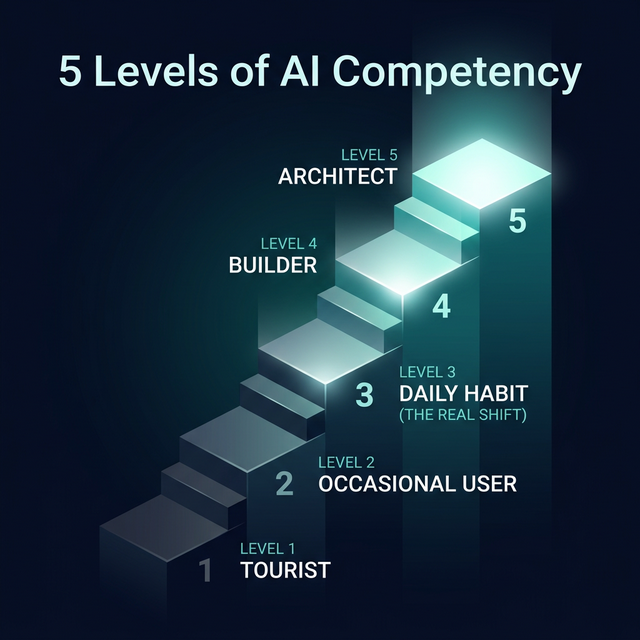
Based on what I've seen in real organizations, most executives are stuck at Level 1. Some haven't even reached that.
Level 1: Tourist. You opened ChatGPT once. You asked "What's the weather like?" or "Write me a birthday message." You closed it and went back to email. This is where most C-level executives are today.
Level 2: Occasional user. You use AI a few times per week. Mostly for rewriting emails or summarizing documents. You treat it like a slightly smarter Google search. Useful, but not changing how you work.
Level 3: Daily habit. You use AI multiple times per day for different tasks. You have custom instructions saved. You've figured out what it's good at and what it's not. You know how to give it context. This is where the real shift happens.
Level 4: Builder. You've created your own prompts that work like small agents. Automated templates. Recurring workflows where AI handles the first draft, the analysis, or the classification. You understand what AI can do because you've built things with it yourself.
Level 5: Architect. You've built small projects. Automations. Prototypes. Not production systems, but working proof-of-concepts that solve real problems. You understand the possibilities AND the limitations because you've hit both.
The gap between Level 1 and Level 3 is the difference between talking about AI and understanding it. The gap between Level 3 and Level 5 is the difference between understanding AI and being able to lead an AI transformation.
What happens when leadership stays at Level 1
I've watched this play out at multiple public companies. The pattern is predictable.
The board approves an AI budget. A project team gets formed. They start working. After three months, they present results. The leadership team asks surface-level questions. The project team gives polished answers. Everyone nods. Nothing meaningful changes.
Why? Because the leaders asking the questions don't have enough personal experience to ask the right ones. They can't tell the difference between a real breakthrough and a well-presented demo. They can't evaluate whether the team solved the core problem or just built something that looks impressive in a meeting room.
And the implementation teams know this. They know their leadership can't actually evaluate AI output. So the bar drops. The standards become "does it look good in a presentation?" instead of "does it change how we work?"
The cobbler needs to wear his own shoes
Here's what I recommend to every executive who's serious about AI. Not what your team should do. What YOU should do, personally.
Start using AI at least five times per day. Not just for email rewrites. Use it to analyze a report. Summarize meeting notes. Generate first drafts of strategic documents. Compare two approaches to a problem. Use it as a thinking partner, not a search engine.
Build three custom prompts. Create reusable instructions for your most common tasks. A prompt that analyzes financial reports in your specific format. A prompt that prepares weekly briefings from your direct reports' updates. A prompt that challenges your strategic assumptions. Save them. Use them regularly.
Create one small automation. It doesn't need to be public. It doesn't need to be perfect. Take one repetitive task from your week and figure out how AI can handle the first 80% of it. The point isn't the automation itself. The point is understanding what building something with AI actually feels like.
Talk about it openly. When you use AI regularly, share your experiences with your team. Show them what worked. Show them what failed. The moment your organization sees that their CEO actually uses AI daily, the entire conversation about adoption shifts. It stops being a mandate from above and becomes a shared challenge everyone is working on together.
What "leading by example" actually means
Last month I spoke with a transformation lead at a major automotive manufacturer. Her biggest frustration? The board kept asking for AI implementation timelines, but when she suggested that each board member spend two hours per week using AI tools personally, the silence in the room was deafening.
Two hours per week. That was too much for the people who approved a multi-million euro AI transformation budget.
This is the shoemaker problem. You can't lead a transformation in something you've never experienced yourself. Previous technology cycles let executives delegate the learning. AI doesn't work that way.
AI is personal. It changes how an individual thinks and works before it changes how an organization operates. If the leadership team skips the personal phase, the organizational phase will fail. They'll set wrong priorities. They'll misjudge timelines. They'll measure the wrong outcomes. Because they're making decisions about something they don't understand from direct experience.
The uncomfortable question
If you're in a leadership position, ask yourself honestly: when was the last time you used AI to solve one of YOUR problems? Not a test. Not a demo someone showed you. A real problem you were dealing with, where you turned to AI as a tool.
If you can't remember, or if the answer is "never," you are the shoemaker whose children walk barefoot.
The good news: this is fixable. Unlike many leadership gaps, this one doesn't require a training program, a consultancy, or a board resolution. It requires opening a tool, asking a real question, and building from there.
Start today. Not with your organization's AI strategy. With your own.