

Last week, former colleagues reached out. They wanted "the AI solution."
Not an AI solution. The AI solution. As if there's a shrink-wrapped box labeled "Supply Chain AI Fix-All" somewhere.
I agreed to meet. Thirty minutes, I figured. Quick diagnostic, point them in the right direction.
One hour later, we hadn't talked about AI once.
The diagnostic
They started explaining their process. Slides that didn't connect. Half-finished process maps. They weren't entirely sure what they had or what they needed.
"We need AI to optimize demand planning," one colleague said. "We want what you built for your team."
Fair request. However, when I asked "What's your biggest pain point in the current process?" the room went quiet.
Not the "thinking hard" kind of quiet. The "we haven't actually defined this" kind of quiet.
I asked simpler questions:
What data do you use today? How do you handle exceptions? What decisions do you make manually vs automatically? Where does the process break down most often?
Every answer started with "Well, it depends..." or "We're not entirely sure..." or "That's a good question."
They didn't need AI. They needed a process audit.
What I tried instead
Instead of ending the meeting (my usual move when someone's not ready), I suggested we record the session.
"Forget AI for a second," I said. "Just walk me through what you actually do. Start to finish. We'll record this, transcribe it, and see what we've got."
For the next 20 minutes, they talked. No slides. No jargon. Just three people describing their daily reality:
"We pull data from SAP, but half the SKUs are miscoded..."
"Customer X always orders off-cycle, so we manually adjust..."
"We don't forecast below MOQ because finance won't approve..."
"Q4 looks weird because we moved to a new ERP mid-year..."
I didn't interrupt. Didn't take notes. Just let them spill.
Then I did the thing they came for — except not the way they expected.
I took the transcript, fed it to an AI with a simple prompt: "Analyze this conversation. Extract: what processes they currently have, what data they actually use, what decisions they make manually, what their real problem is (not what they think it is), what would need to exist before AI could help."
Three minutes later, I had a 2-page document that I sent back to them.
Their response?
"This is the most accurate description of our problem we've ever seen. How did you know all this?"
I didn't. They did. They just needed something to organize the chaos they'd been living in.
Why most AI pilots fail
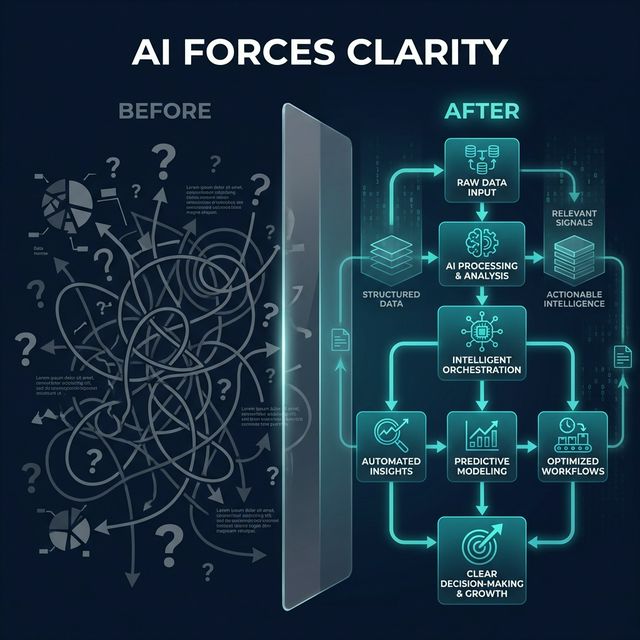
The technology works. The teams are smart. The vendors don't oversell (usually).
Projects fail because companies skip Step Zero: understanding what you actually do.
You can't train an AI apprentice if you don't know what the job is.
Think about hiring a demand planner. Nobody says "We need a demand planner. Find someone with 5 years of experience. Start Monday." You give them your product hierarchy, seasonality rules, exception protocols, and decision framework. Then you find someone who can execute.
Yet that's exactly how we deploy AI.
We throw ChatGPT at S&OE prep. We run a Copilot pilot. We buy an "AI-powered forecasting tool."
Then we're shocked when it produces generic outputs that look professional but miss every edge case that makes our business unique.
The AI isn't the problem. We never taught it what makes us different.
What to do before you buy anything
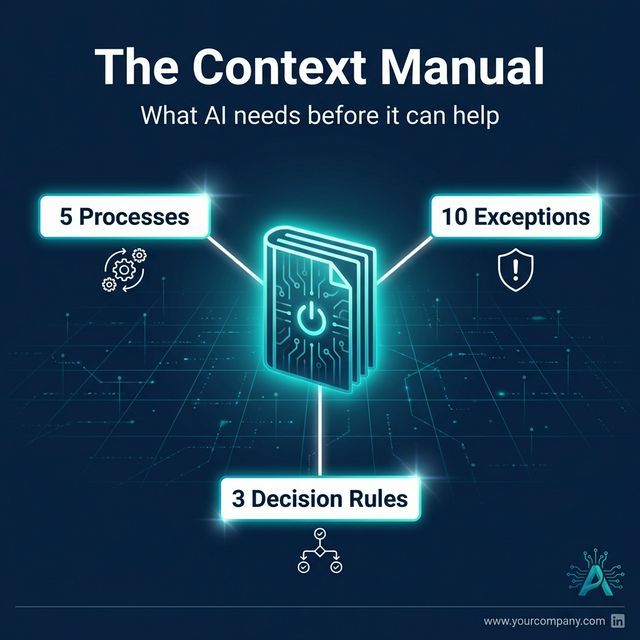
If you're serious about AI — actually using it, not just piloting it — here's what you do before you buy a tool, hire a vendor, or write a single prompt:
Record what you actually do. Not what the SOP says. Not what you wish you did. What you actually do. Record a working session. Transcribe it. Feed it to AI with this prompt: "What processes, decisions, and exceptions are described here?" People describe reality differently when they're not performing for management.
Build the context manual. Minimum viable context: 5 critical processes (end-to-end, no jargon), 10 key exceptions (the edge cases your team handles daily), 3 decision rules (when to escalate, when to execute, when to ignore). No 50-page document. No consultant engagement. Just the truth about what makes your operation yours.
Start small, measure everything. Pick the most boring, repetitive, low-risk task you have. Give AI the context manual. Let it try. Review. Correct it and explain why. Repeat. Measure accuracy and time saved. If both are "yes" after 10 iterations, expand. If not, your context manual is incomplete.
What I learned (the expensive way)
I spent 6 weeks using AI wrong before I figured this out.
I gave an AI agent a demand planning task with zero context. No product hierarchy. No seasonality rules. No customer quirks.
It generated a forecast that looked perfect — until I noticed it predicted a Christmas peak for industrial B2B customers.
Useless.
The fix wasn't a better model. It was a better manual.
I wrote down product categories, seasonality patterns (Q4 is our slowest quarter, not our busiest), customer exceptions (Key Account Y runs on fiscal May-April), operational constraints (never forecast below MOQ).
Next output: 85% usable. No rework required.
Same AI. Same data. Different context.
AI doesn't fail because it's not smart enough. It fails because we don't teach it what "smart" means in our world.
If you can't explain your process to an AI, you probably can't explain it to a new hire either. And if you can't explain it to a new hire, you don't have a process — you have institutional chaos held together by tribal knowledge.
AI forces clarity. That's why it's uncomfortable. That's also why it's valuable.
The companies winning with AI aren't the ones with the best models. They're the ones who did the boring work first: documented their processes, defined their exceptions, wrote down their decision rules. They didn't skip Step Zero.
What to do next
You don't need a pilot program. You don't need budget approval. You don't need a vendor.
You need 30 minutes and a phone.
Pick one recurring task (weekly report, forecast update, exception triage). Record yourself doing it. Transcribe and analyze it with free AI tools. Ask the AI: "What's the process here? What are the exceptions? What decisions get made?"
If the output is 80% accurate, you're ready for the next step.
If it's not, you just learned something more valuable: you don't actually know your own process yet.
Fix that first. Then come back for the AI.