
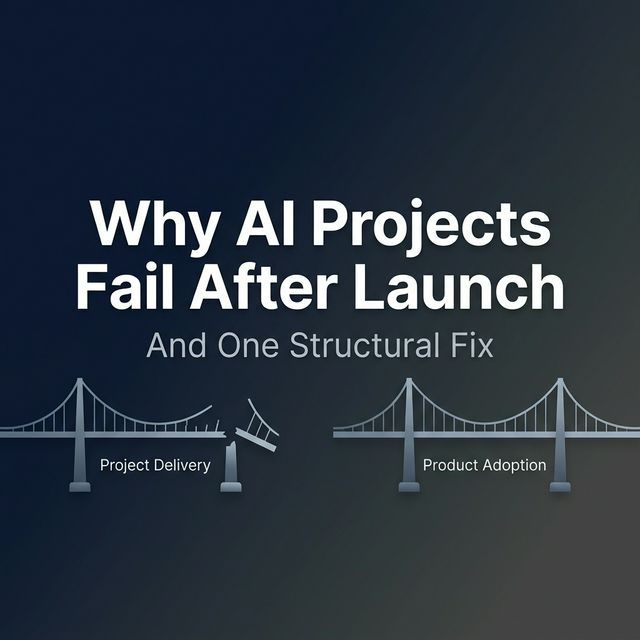
A project leader is appointed. A team is assembled. A tool gets built, tested, deployed. The project closes. The leader moves on.
Six months later, adoption is at 30%. The tool exists. Nobody uses it the way it was designed. The capability dies quietly.
This is not a technology problem. It is a structural one.
The pattern is familiar. It predates AI. We ran supply chain transformation projects the same way for decades. The difference today is scale and speed. AI initiatives move faster, touch more people, and fail more visibly.
The root cause is always the same: we confuse delivery with adoption.
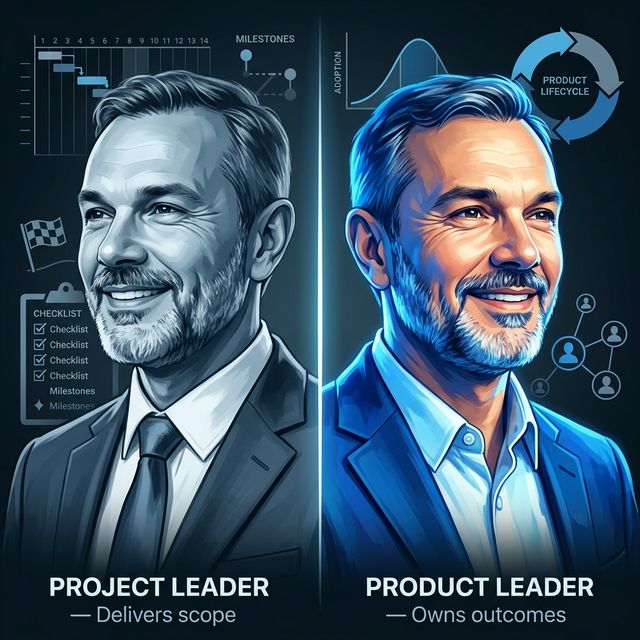
A project leader's job is to deliver a defined scope on time and within budget. That is a complete and valuable job. However, it ends at go-live. The moment the project closes, ownership of what was built becomes unclear. Teams inherit a tool without a clear owner. Issues pile up. Workarounds multiply. The original intent gets lost.
Product thinking solves this. Most AI initiatives never make that shift.
I have seen this pattern from the inside.
Over the past few years, my team delivered several projects that had been stuck or dismissed as impossible for years. We shipped working solutions. I was satisfied with the delivery.
However, when I look at adoption across the wider organization, the picture is uneven. Some teams picked it up immediately and built on it. Others, after one or two years, still have not fully integrated what we built. The tool works. The process exists. The gap is not technical.
That observation is what pushed me to rethink the structure entirely.
The model I am now implementing across six AI projects
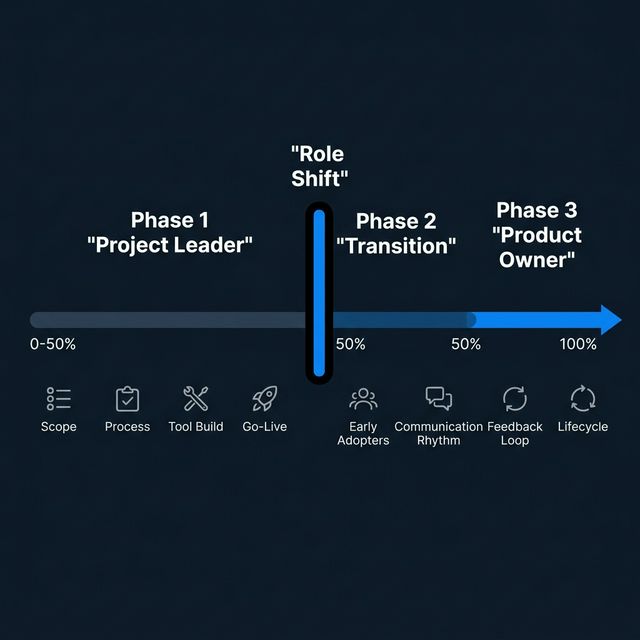
Each project has one person accountable from start to scale. In the first phase, they operate as a project leader. They coordinate with stakeholders, define the process, select and shape the AI tool, manage timelines. Standard project execution.
At roughly 50% through implementation, the role begins to shift. The same person starts allocating time as a product manager. Not after launch. During it.
They begin managing the adoption pipeline. Early adopters are identified. Communication runs on a stable rhythm. Users know what to expect before they are asked to change their behavior. They own the full lifecycle. Not just delivery.
By the time the tool reaches full deployment, there is already an engaged user base, a feedback loop in place, and a clear owner for what comes next.
The distinction matters
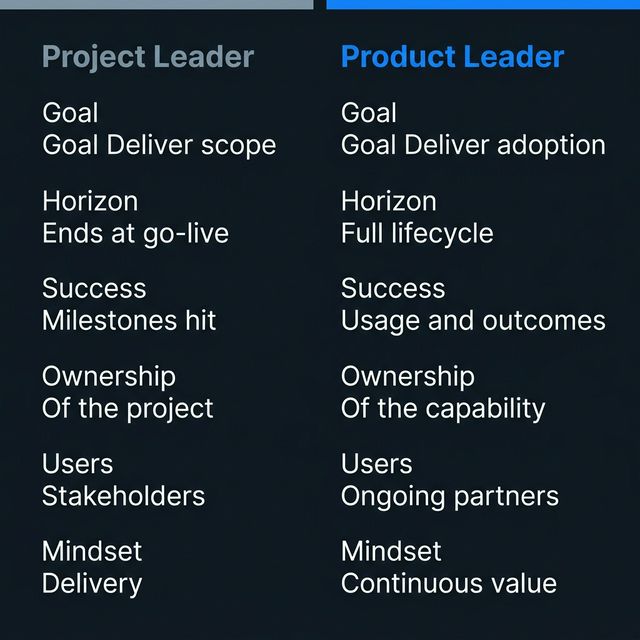
| Project Leader | Product Leader | |
|---|---|---|
| Primary goal | Deliver scope on time and on budget | Deliver capability that actually gets used |
| Time horizon | Ends at go-live | Continues through the full lifecycle |
| Success metric | Project closed, milestones hit | Adoption rate, business outcomes, user engagement |
| Ownership | Of the project | Of the capability and its results |
| Relationship with users | Manages stakeholders during delivery | Maintains users as ongoing partners |
| Mindset shift | From firefighting to systems thinking | From delivery to continuous value creation |
This is harder than the standard approach. It demands more from the people running these projects. They need to understand both project mechanics and change management. The combination is rare.
However, in complex environments where AI touches core processes, the alternative is not a cheaper path. It is just a path that fails more slowly and less visibly.
The projects that survive past year one are not the ones with the best technology. They are the ones with a clear owner who stayed in the room after launch day.
I am running this model across six AI initiatives, each scoped to a specific process domain, each led by a person who starts as a project leader and transitions into a product owner. Different tools. Different teams. One consistent structure.
It is early. However, the pattern of who engages and how they engage already looks different from what I have seen in traditional project setups.
If you are designing your AI rollout and wondering why previous initiatives did not hold, this is likely one of the structural reasons.
The fix is not complex. It requires one committed person per project, and the willingness to redefine what "done" actually means.
If you are working through a similar challenge, feel free to reach out.