
Last week, the working thesis was simple: a demo is not adoption.
That sentence matters because many AI discussions still stop at the wrong moment. The model answers. The screen looks convincing. The sponsor sees potential. The team can say the pilot works.
Then Monday morning arrives.
The planner opens the same spreadsheet. The manager reviews the same report. Exceptions move upward again because nobody knows who owns the unusual case. The recommendation exists, but the workflow has not changed.
This is where many pilots lose value. Not through a visible failure. Through a quiet return to the old operating model.
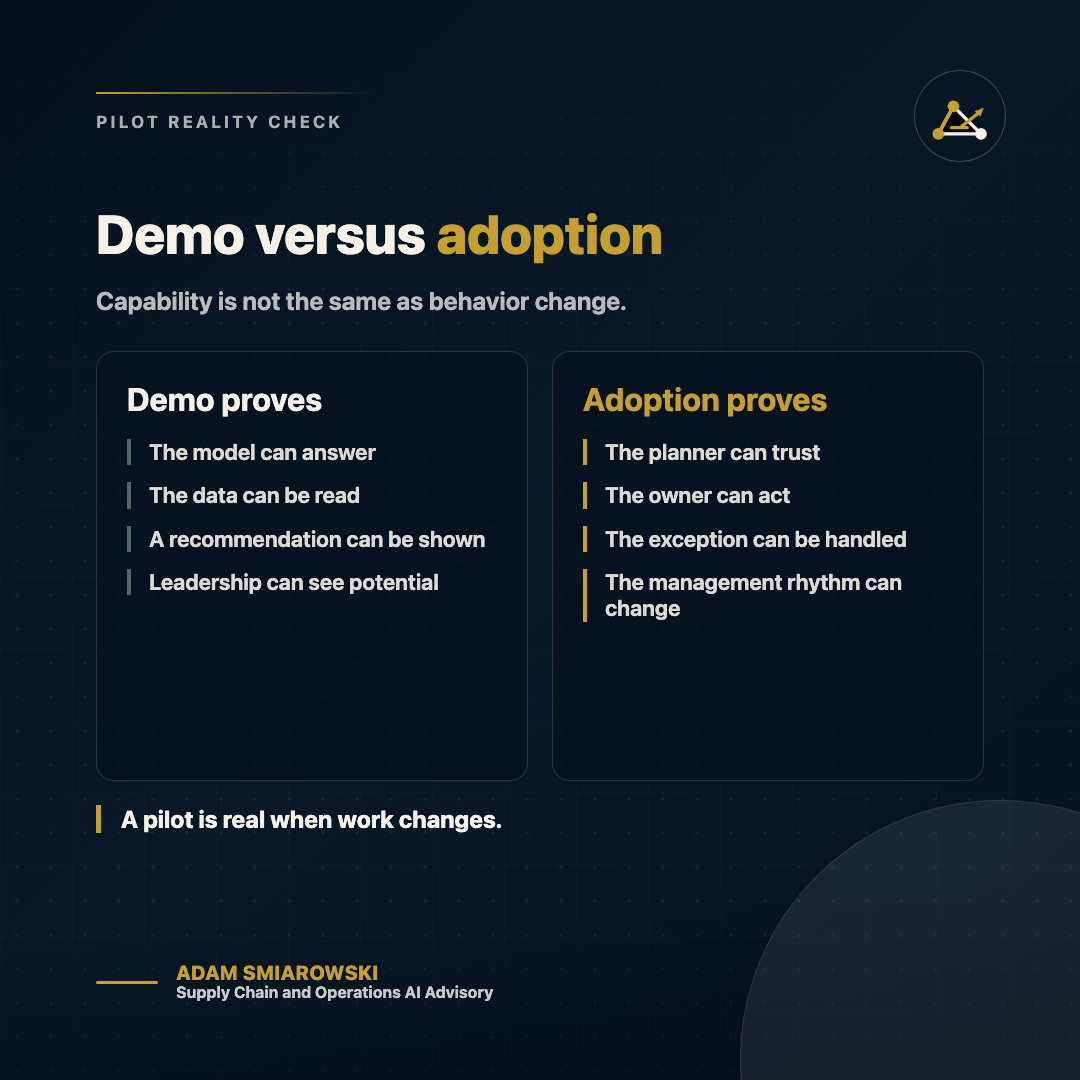
A demo proves technical capability. Adoption proves that people can trust the output, act on it and change the way work moves.
Capability is not behavior change
An AI demo usually proves that a system can produce an answer under controlled conditions.
That is useful. It reduces technical uncertainty. It can show whether the model reads the right inputs, generates a recommendation and explains its logic well enough for a user to consider it.
But the demo does not prove that the organization can use the answer.
Operational value starts later. It starts when someone changes a decision, removes a manual step, reviews a different signal or escalates to a different owner. If none of that happens, the AI pilot has added attention, but not value.
This is why I would separate two questions before calling any pilot successful.
| Question | What it proves |
|---|---|
| Can the system produce a useful output? | Technical capability. |
| Can the organization act differently because of that output? | Operational adoption. |
The second question is harder. It is also the one that determines whether the pilot deserves more funding.
Five signals that adoption has not started
The first signal is that the output lives outside the workflow.
The AI gives an answer, but the user still copies it into another file or another process. The pilot has not removed work. It has created an extra step that people tolerate during the experiment and abandon later.
The second signal is that every recommendation is still validated in Excel.
This does not mean Excel is bad. It means trust has not moved. The official system gives a recommendation, but the real decision still happens in the old file. If that pattern stays, the new tool becomes decoration around the old operating model.
The third signal is unclear exception ownership.
An AI agent can flag a shortage, a demand shift or an inventory risk. It cannot decide by itself who must act when the case is unusual. If the exception owner is unclear, every difficult case returns to escalation.
The fourth signal is an unchanged management meeting.
If the same report is reviewed, the same questions are asked and the same decisions are delayed, the pilot is still outside operations. The model may be better, but the management rhythm has not absorbed it.
The fifth signal is a KPI that sits too far from the decision.
A technical metric can prove that the model improved. It does not prove that service, cost, inventory, capacity or speed improved. The KPI must connect to the decision being changed.
These signals are not research findings. They are practical checks for leaders who need to know whether an AI pilot is moving from presentation to work.
The pilot graveyard is quiet
Many pilots do not crash. They fade.
Usage falls after the launch. The spreadsheet returns. The meeting stays the same. The team keeps the AI output available, but the real process quietly resets.
Nothing looks broken enough to trigger a serious review.
That is still failure.
The dangerous part is that it creates a false story. The organization says it tried AI and did not see enough value. In reality, it may have tested a model without changing the workflow, ownership or decision rhythm needed to turn the model into value.
The Monday morning test
My preferred adoption test is simple.
Look at Monday morning.
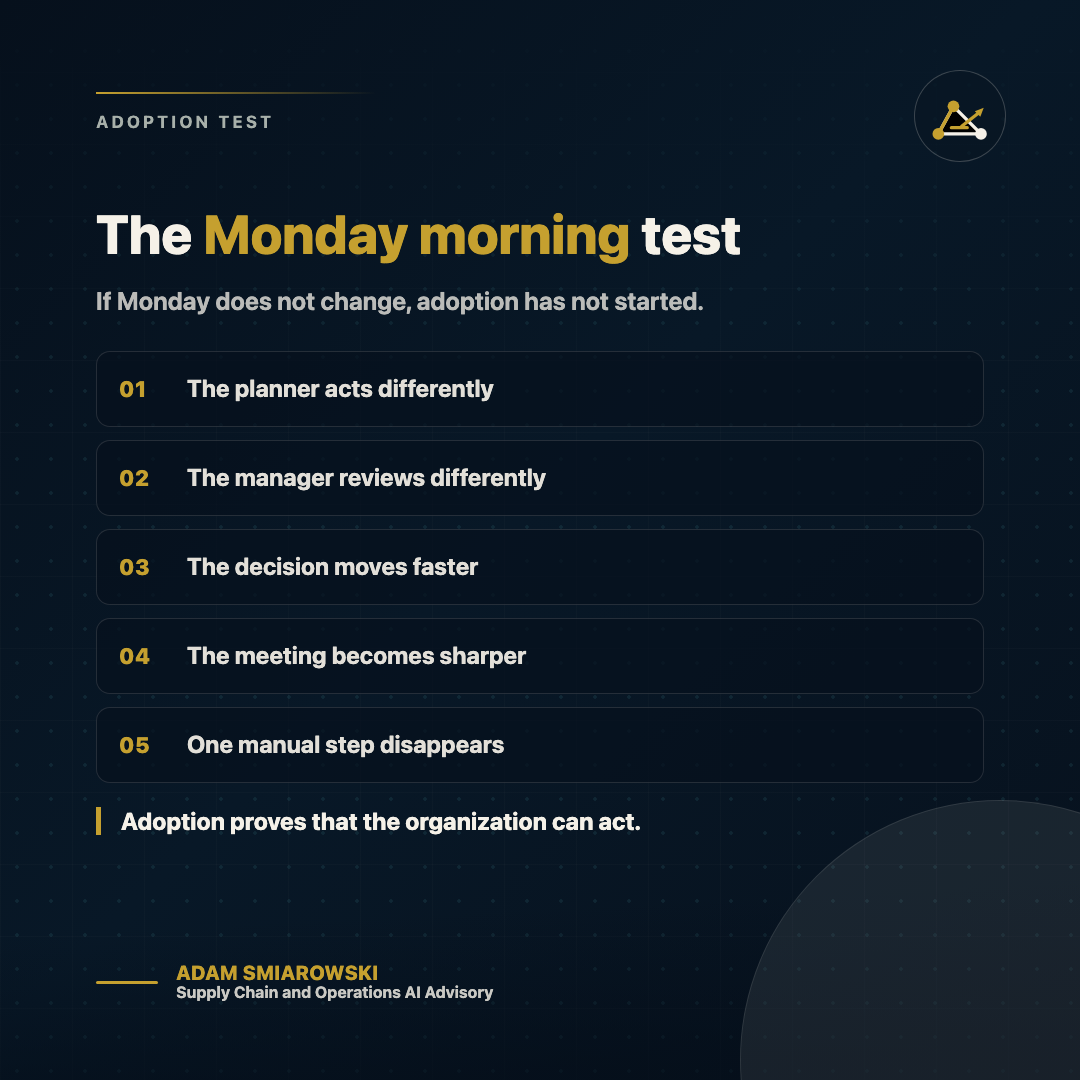
Does the planner act differently?
Does the manager review differently?
Does the decision move faster?
Is the meeting sharper?
Did one manual step disappear?
If the answer is no, adoption has not started. The demo may still be strong. The model may still be accurate. But the organization has not converted capability into action.
What sponsors should ask after the demo
After a good demo, the sponsor should not ask for a longer feature list first.
I would ask seven operational questions.
- Which recurring decision will change?
- Who owns the outcome of that decision?
- Where will the output enter the real workflow?
- Which manual step should disappear?
- Which exception needs a named owner?
- Which business KPI proves value?
- What changes in the management review after launch?
If these answers are unclear, the pilot is not ready to scale. It may still be worth continuing, but the next work is not another demo. The next work is operating model design.
What to do next
Pick one AI pilot and run the Monday morning test.
Do not start with the model. Start with the work.
Trace one recommendation from output to action. Find the owner, the workflow step, the exception rule, the KPI and the meeting where the decision is reviewed. If the path is unclear, fix that path before adding more capability.
A strong demo creates interest.
A changed workflow creates value.
Next theme: Excel is not the problem. It is often the evidence that the operating model is unclear.